Why a new system can still run badly
Buying a new air conditioner does not guarantee a cool house. The equipment is only part of it. A condenser set on an uneven pad vibrates and fatigues its lines. A line set run with a kink or left undersized starves the compressor. A coil that does not match the outdoor unit, or an air handler in the attic wired to the wrong stage, leaves you with a brand new system that behaves like the old one.
In Tomball the attic does a lot of the damage. Ducts that were fine years ago sag, split at the collars, or sit under insulation that has settled. Put a good condenser on a poor duct system and the new equipment gets blamed for what the ductwork is doing. A proper replacement looks at the whole path the air takes, from the return grille to the supply register in the farthest bedroom.
The other failure is the one T Phillips described in a Google review: the last company put the wrong part in a new air conditioner. A wrong metering device or mismatched component can run for years before anyone notices the electric bill. Matching the indoor and outdoor equipment is the first job, not an afterthought.
How the crew sets up a full system
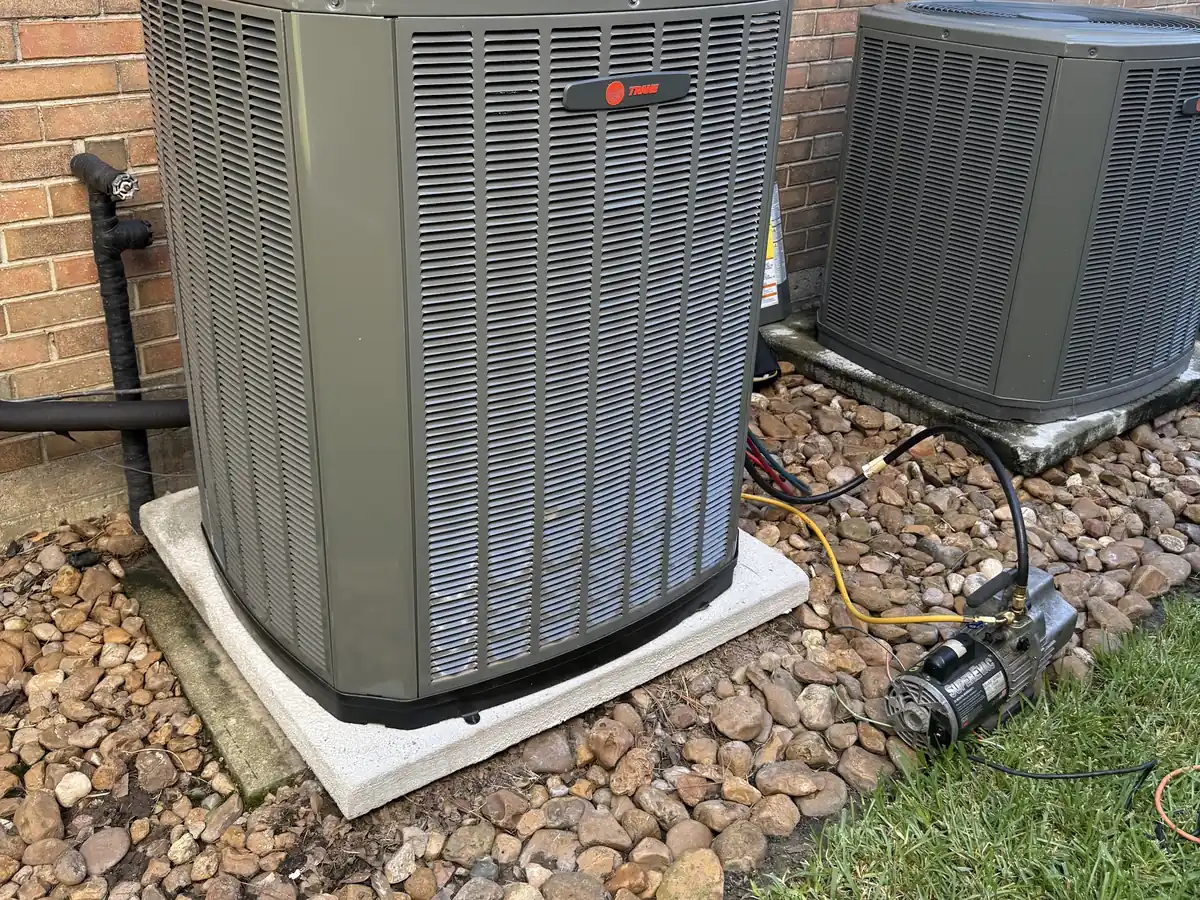
Dave Lane's is a Trane Comfort Specialist and services all major brands, so the replacement is chosen for your house and not for a shelf. The photo on this page shows the stage that matters: two new Trane condensers on concrete pads, with a vacuum pump connected to the service valves. That vacuum step is the one that does not show on an invoice. Pulling the lines down removes air and moisture before refrigerant goes in, and a system that skips it carries a problem inside its own piping.
Install work moves in a fixed order. The old equipment comes out and the pad is checked and levelled. The new condenser is set, the line set connected and brazed, and the indoor coil and air handler matched to it. Electrical, condensate drain and thermostat follow, then the vacuum, the charge, and a full commissioning check with the system running. The final check is done with the system running, reading pressures and temperature split against the equipment's own specifications.
Speed matters when the house is hot, and the crew works that way. Johnny Bueller wrote that the team "completed a Full AC & Heating set up in 7 hrs" and that Ryan "was great and very informative." His words for the whole experience were that they "made a stressful experience pain free." Nothing in that is a promise about your job, because every attic and every slab is different. It does show what a coordinated crew with one person explaining each step looks like.
What to watch for after the truck leaves
A new system should be quiet, cycle on and off at a steady rhythm, and hold the temperature you set without long runs. If the outdoor fan hums but does not spin, the indoor coil ices over, or one room stays warmer than the rest, tell the installers early. Those are the signs that something at commissioning or in the ductwork needs another look, and they are far easier to fix in the first season than the fifth.
Keep the area around the condenser clear of grass clippings and fence debris, and keep filters changed. Maintenance protects the investment: a coil that stays clean runs cooler and lasts longer. The same team that installs the system services it, so the person who set it up is a phone call away.
Replacement quotes start with a conversation. Call (713) 960-4269 and the family at Dave Lane's will talk through your house, your current system and what you want from the next one. The shop at 17857 Hufsmith-Kohrville Road is open seven days a week. If you are not sure whether to repair or replace, the repair page explains how a diagnosis decides it.