A dirty coil, a slow drain and a blower working too hard
In most Tomball homes the air handler lives in the attic, which means the evaporator coil is the part of the system you never see and the part that quietly decides how the whole thing behaves. Dust that gets past the filter settles on the coil fins. The coil is cold and wet all summer, so that dust turns into a film. Air struggles through it, the blower has to push harder to move the same amount of air, and the house takes longer to cool. Nothing breaks on day one. The system just works a little harder every month until it does break.
The drain is the second thing that fails without announcing itself. Every pound of moisture the coil pulls out of a Houston-area summer has to leave through the condensate line, and that line runs through an attic that is hotter than the street. Algae and sludge collect in the pan and the trap. A float switch trips, the system shuts off, and the first sign the homeowner sees is a warm house or a stain on a ceiling. The fan coil, the blower and the motor that drives it, is the third. A blower fighting a clogged coil draws more current, runs hotter, and wears its bearings faster than one moving clean air.
None of this shows up on a thermostat. It shows up as a longer cooling afternoon, a musty smell when the system starts, an ice patch on the line set, or a bill that climbs for no reason you can name. That is what maintenance is for: finding the film, the sludge and the strain while they are still cheap to deal with.
Coil cleaning, fan coil repair and replacement, and the findings said out loud
Dave Lane's services the evaporator and the fan coil as a job of its own: cleaning, repairs and replacements. The technician opens the air handler, looks at the coil face and the pan before touching anything, and checks the blower wheel and motor. Cleaning is for a coil that is dirty but sound. Repair is for a fan coil with a failing motor or a leak you can locate. Replacement is for the coil or fan coil that has reached the end of its life. Which one applies is a finding, not a sales position, and it comes from what the technician sees in the unit.
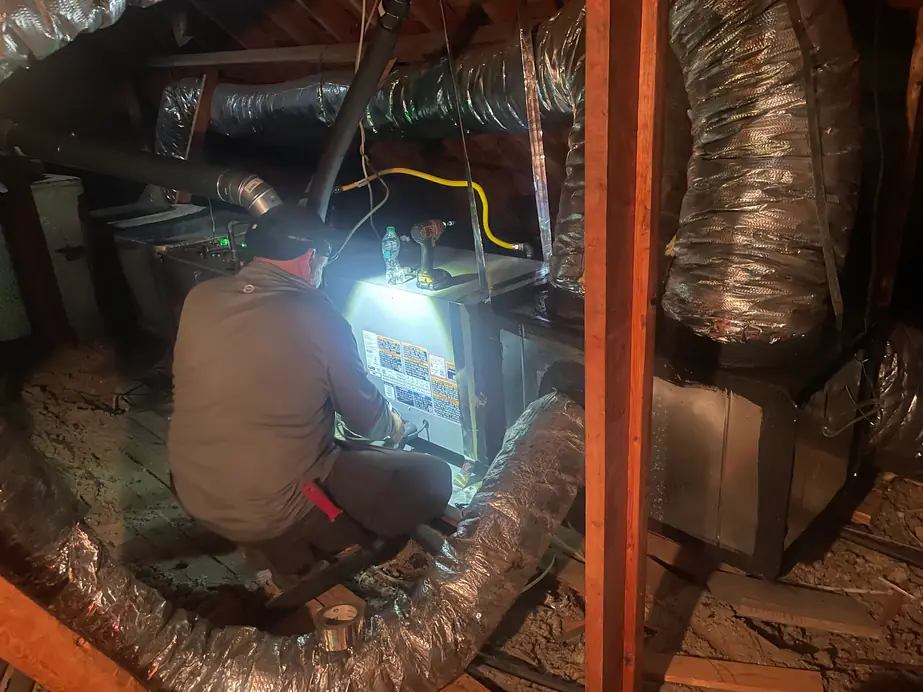
The photograph at the top of this page is one of the team's own: a technician crouched at an attic air handler under a headlamp, with ductwork running in every direction around him. That is the working conditions for this trade in Texas, and it is why the walk-through matters. A homeowner is not going to climb into that space to check. Crucita Torres, writing on Google, described the team as "Very knowledgeable, they walk you through all their findings and explain the repairs needed." On a coil and fan job, that explanation is the product: what the coil looked like, what the drain looked like, what the blower was drawing, and what was done about each.
The technicians are NATE certified, and the company is a Trane Comfort Specialist that services all major brands, so a coil in a unit from another manufacturer gets the same attention. Frank Motycka noted that his technician phoned ahead with his arrival time, which is the first stop on the red carpet and applies to a maintenance visit as much as an emergency one.
UV lights, air purifiers and the air you breathe afterwards
The same visit is the natural moment to talk about indoor air. Dave Lane's installs HVAC UV lights, which are mounted by the coil where the damp surface is, and works on indoor air quality with air purifiers and ventilation improvements. These are add-ons to a system that is already clean and moving air properly, not a replacement for it. A purifier on a system with a caked coil is treating the symptom, so the order of operations matters: clean and correct first, then improve.
What you should expect afterwards is simple. Air that moves freely through a clean coil, a condensate line that runs, and a blower that is not straining. How often a given home needs the coil and drain looked at depends on the house, the filter habits and the equipment, and the technician can tell you what they saw and what they would watch next time. If something is near the end of its life, you hear that now, in plain words, instead of on the hottest weekend of the year.
The shop on Hufsmith-Kohrville Road is open seven days a week, 8:00 AM to 7:00 PM on weekdays and 9:00 AM to 5:00 PM on Saturday and Sunday. Call (713) 960-4269 to book a visit anywhere in Tomball, Spring, The Woodlands, Cypress, Katy or Houston.