AC Blowing Warm Air: What You Can Safely Check Before You Call
Five minutes with the thermostat, the filter and the outdoor unit explains more breakdowns than you'd expect.
October 20, 2026 · 4 min read
It's four in the afternoon in July, and the air coming out of the vents feels like a hair dryer on low. Before you assume the worst, a handful of checks are safe for any homeowner and explain a surprising share of warm-air calls. None of them need tools. None of them involve opening a panel. If they don't fix it, you'll at least have useful information for the technician.
Start at the thermostat
The thermostat is the control for everything, so check it first. Make sure it's set to cool, not heat or off, and that the temperature setting is a few degrees below what the room currently reads. Look at the fan setting too. If it's on "on" instead of "auto," the blower runs constantly, including between cooling cycles, and it will push room-temperature air out of the vents whenever the compressor is off. That feels like warm air and isn't a fault.
If the screen is blank or dim, replace the batteries if your model uses them. A dead thermostat can leave the system doing nothing at all. And if the display looks fine but the system never responds, the thermostat itself may be failing. One Google reviewer, Frank Motycka, wrote: "I had a simple, but urgent problem with my thermostat. He quickly replaced it and double checked that everything worked." Sometimes the cheap-looking part is the whole problem.
Look at the filter and the airflow
Slide out the air filter and hold it up to a light. If you can barely see light through it, it's choked. A clogged filter starves the system of air. In the worst case the indoor coil gets so cold, so fast, that it freezes over and then nothing cools the house at all. Replace the filter, and check that the vents in each room are open and not blocked by furniture or rugs.
Check the breaker and the outdoor unit
Your AC has two sides, indoor and outdoor, and each has its own power. At the electrical panel, look for a tripped breaker for the air conditioner. If you find one, switch it fully off and then on again, once. If it trips again, stop. A breaker that keeps tripping is telling you about a real electrical problem, and resetting it over and over is how small faults turn into expensive ones.
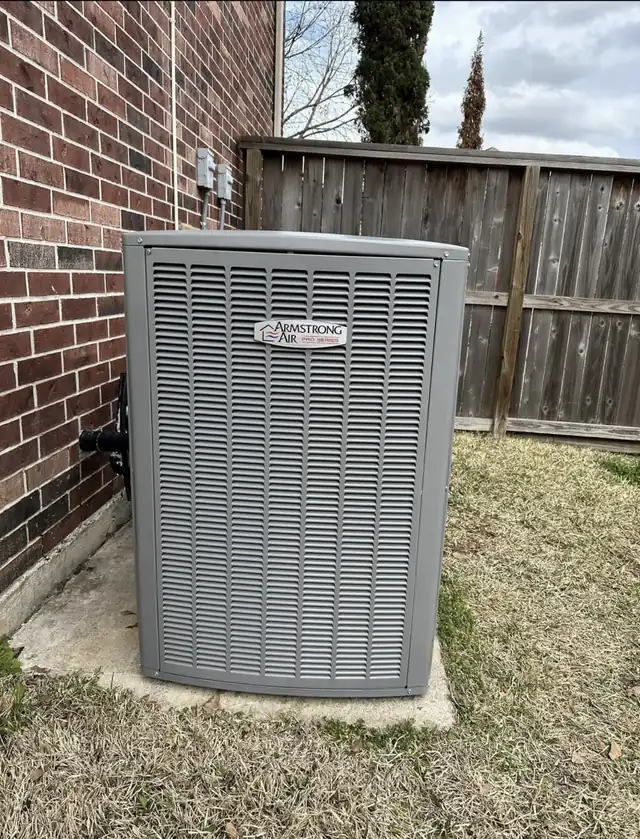
Then walk outside to the condenser, the big fan unit on the pad beside the house, like the one in the photo above. Is the fan turning? Is it humming but not spinning? Look around it. Grass clippings, leaves, cottonwood fluff and a stack of boxes leaned against it all choke the airflow the unit needs to shed heat. If the fins are packed with debris and the power is off at the outdoor disconnect, you can clear loose material by hand or rinse it gently with a garden hose. Don't use a pressure washer, and don't bend the fins.
Ice is a signal, not a mystery
If you see ice on the copper line running to the outdoor unit, or frost on the indoor unit near the attic or closet, turn the cooling off at the thermostat. Leave the fan on to help it thaw. Don't chip at it or use a hair dryer on it. Ice means the coil got too cold, which comes from restricted airflow, a dirty coil or low refrigerant. Thawing it gets you cool air for a while, but the cause is still there.
When to stop and call
Some situations call for a technician rather than more experimenting:
- The breaker trips again after one reset.
- You smell burning or hot electrical odors from the air handler or the outdoor unit.
- There's water around the air handler or a stain growing on a ceiling.
- Ice comes back after you've changed the filter and let it thaw.
- The outdoor unit hums or clicks but the fan doesn't turn.
Please don't try to add refrigerant yourself. Refrigerant doesn't get used up like fuel. If the level is low, it leaked, and the leak needs to be found and fixed, not topped off. The same goes for opening the electrical panels on the equipment. The capacitors inside can hurt you even with the thermostat off.
When you do call, say what you've already checked. It saves time and helps the technician start in the right place. Another Google reviewer, Crucita Torres, described the team as "Very knowledgeable, they walk you through all their findings and explain the repairs needed."
Dave Lane's Hi-Tech Mechanical is open seven days a week, Monday to Friday 8:00 AM to 7:00 PM and Saturday and Sunday 9:00 AM to 5:00 PM. Call (713) 960-4269, or read more on the AC repair page at /services/ac-repair.
Dave Lane's Hi-Tech Mechanical Inc., (713) 960-4269
Call (713) 960-4269More articles
Why Your AC Runs All Afternoon When the Air Handler Lives in the Attic
A long run cycle on an August afternoon isn't always a broken system, but it is always a clue about your attic.
What "Pulling a Vacuum" Means on a New AC Install, and Why to Ask About It
It's one of the least visible steps of a new installation, and one of the easiest to skip without you ever knowing.