What "Pulling a Vacuum" Means on a New AC Install, and Why to Ask About It
It's one of the least visible steps of a new installation, and one of the easiest to skip without you ever knowing.
October 20, 2026 · 4 min read
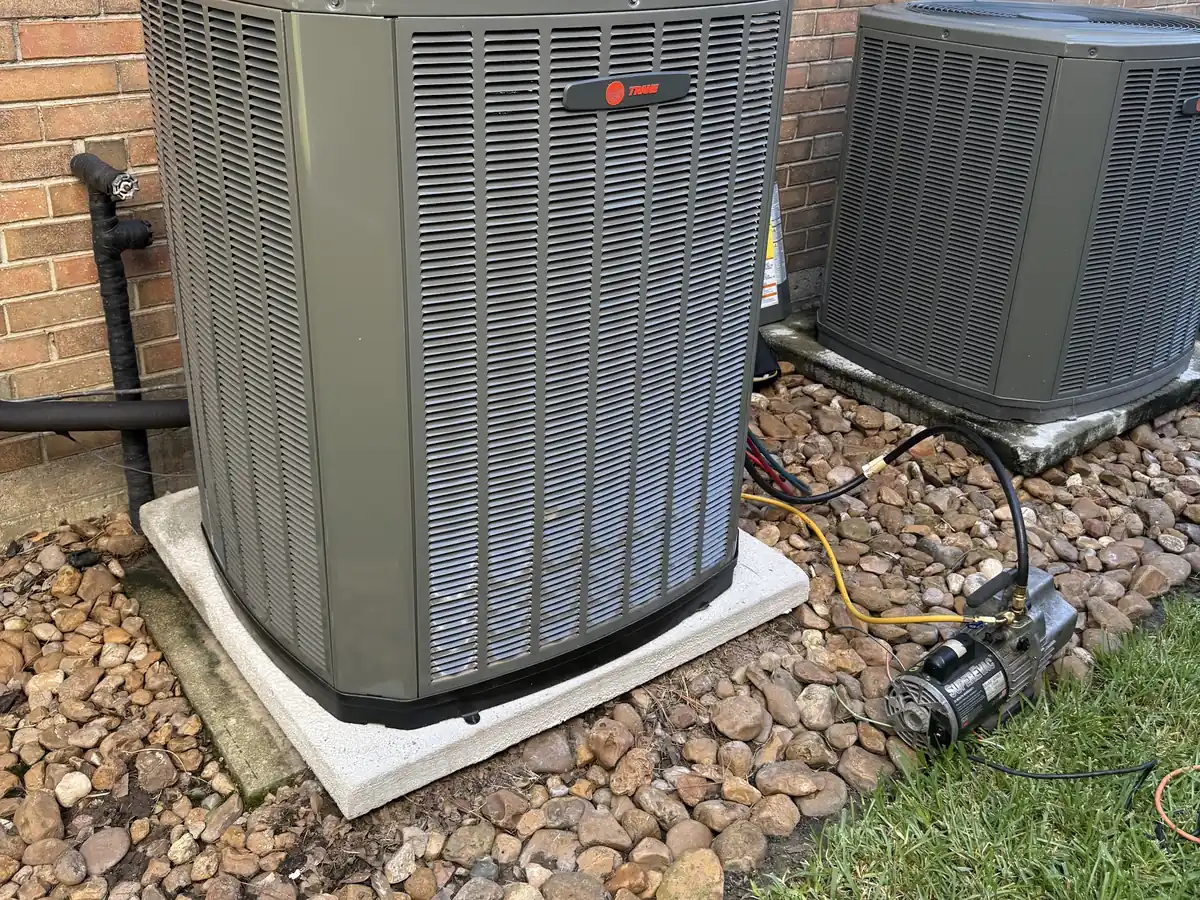
When a new air conditioner goes in, you see the big parts: the condenser lowered onto its pad, the air handler set in the attic, the new thermostat on the wall. What you don't see is the part that decides whether all that equipment lasts. Before refrigerant is released into a new system, a good installer pulls a vacuum on it. If you ever look out the window mid-install and see a small pump, a set of hoses and a gauge hooked up to the outdoor unit, that's what's happening. The photo above shows exactly that, on one of this team's own Trane installs, with the vacuum pump still connected beside the new condensers.
What the vacuum is actually doing
An AC system is a sealed loop of copper tubing. Refrigerant circulates through it, carrying heat out of your house. The loop is only supposed to contain refrigerant and a little oil. When the installer connects the outdoor unit to the indoor coil with a line set, that tubing has been sitting in open air. It has air in it, and air carries humidity, which is a lot of humidity in Gulf Coast weather.
The vacuum pump pulls that air and moisture out of the loop before the system is charged. Air that stays inside takes up room and upsets how the system runs. Moisture that stays inside is worse, because it mixes with the oil and the refrigerant and works against the compressor and the parts around it for as long as the system runs. A properly evacuated system starts its life dry and sealed.
The part that matters: watching the gauge hold
Running a pump for a while isn't the whole job. The proof is in what happens after. The installer pulls the system down, closes off the pump and watches the gauge. If the reading stays put, the loop is tight and dry. If it creeps back up, one of two things is going on: there's a leak somewhere in the connections, or there's still moisture inside boiling off into the empty space. Either one needs to be dealt with before anyone opens the valves and lets refrigerant in.
Many installers also pressurize the lines with nitrogen first to check for leaks, then pull the vacuum. You don't need to memorize the order. What you want to know is that the loop was tested for tightness and the gauge was watched, not that a pump was switched on and the crew walked away to carry other equipment.
Questions worth asking before you sign
You don't have to be technical to ask good questions. A few plain ones will tell you a lot about how a company works:
- Do you pull a vacuum on every new installation, including replacements that reuse some existing parts?
- What gauge do you use to confirm it, and do you let it sit and watch whether the reading holds?
- Will the technician who sets the equipment also be the one who starts it up and checks it?
- After startup, what do you check? Airflow, temperatures, the drain line, the thermostat settings?
A confident answer sounds like a routine, not a sales pitch. A vague answer, or "we don't usually need to," is worth noticing. The installer who has done it a thousand times will be happy to tell you about it, because it's part of the job they take pride in.
Startup is where installs are won or lost
Pulling a vacuum is one step in what the trade calls commissioning, the process of proving a new system works as designed before the crew leaves. After the vacuum, the refrigerant goes in, the system starts, and the technician checks that it's cooling the way it should, the air is moving the way it should and the condensate drains where it should. The thermostat gets set up and tested.
This is also where a mismatched or wrong component shows up. One Google reviewer, T Phillips, wrote to thank the team for "figuring out the last air-conditioning company put the wrong part in my new air conditioner." That's the kind of thing a careful startup is meant to catch the day the system goes in, rather than after years of a house that never cools right.
Dave Lane's Hi-Tech Mechanical is a Trane Comfort Specialist, services all major brands, and employs NATE certified technicians. Family run since 1976, it holds Texas licences TACLA107998E and TACLB020181E. None of that replaces asking the questions above of anybody you hire, but it does tell you who is standing behind the install.
Planning a replacement and want to hear how an installation is run before you commit? Call (713) 960-4269, or read about the process on the AC installation page at /services/ac-installation.
Dave Lane's Hi-Tech Mechanical Inc., (713) 960-4269
Call (713) 960-4269More articles
Why Your AC Runs All Afternoon When the Air Handler Lives in the Attic
A long run cycle on an August afternoon isn't always a broken system, but it is always a clue about your attic.
Heat Pump or Gas Furnace for a North Houston Winter?
Most winters here are a handful of cold weeks, which changes the question you should be asking.