Heat Pump or Gas Furnace for a North Houston Winter?
Most winters here are a handful of cold weeks, which changes the question you should be asking.
October 20, 2026 · 4 min read
In Tomball, Spring and The Woodlands, you run the air conditioner most of the year and the heat for a few cold stretches between December and February. Some years there's a hard freeze or two. Many winter days are mild enough that you wonder why you own a heater at all. That pattern is the reason the heat pump versus gas furnace question comes up so often when it's time to replace an old system, and the answer depends on how you live more than on any single rule.
How a gas furnace heats
A gas furnace burns natural gas in a sealed combustion chamber, passes the hot gases through a heat exchanger and blows your home's air across it. The exhaust leaves through a flue, which is the vent pipe you see running out of the top of the unit. The air that comes out of your registers is noticeably hot, and a furnace can warm a cold house quickly.
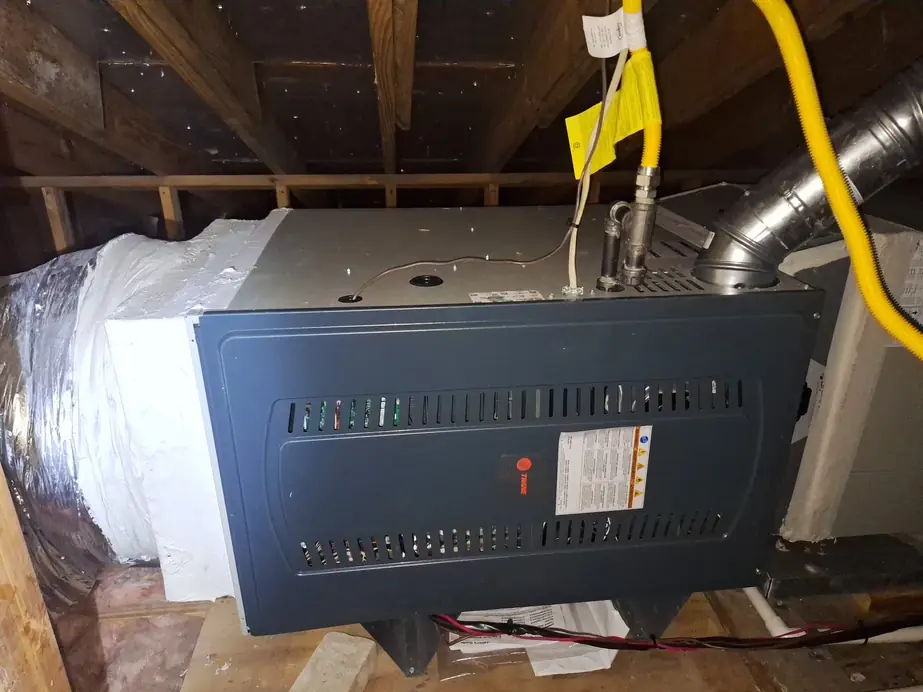
The photo above shows a Trane gas furnace set horizontally in an attic, with a new yellow gas line connector and a flue collar. Horizontal installs like this are common in Houston-area homes, where the attic holds the air handler. It needs a gas supply to the house, and it needs the flue and combustion air arranged properly, which is why a clean install is mostly about the details around the furnace.
How a heat pump heats
A heat pump is an air conditioner that can run in both directions. In summer it moves heat out of your house. In winter it reverses and pulls heat from the outdoor air into the house. There's no flame and no flue. The outdoor unit looks like a regular condenser, and the indoor air handler is much the same as the one you already have.
The air from a heat pump feels different. It's warm, but it isn't the hot blast a furnace produces, so some people read it as weak heat when it's actually doing its job. Heat pumps also usually come with a backup source for the coldest weather, either electric heat strips in the air handler or a gas furnace paired with the heat pump in a dual setup. How that backup is arranged is a design choice worth asking about.
Which fits a north Houston house
A few real-world questions usually settle it:
- Is natural gas already piped to your house, and is your current furnace the only thing using it? A heat pump can remove the need for a gas connection to the equipment.
- How do you feel about the type of heat? If you like the hot, fast air of a furnace on a 30 degree morning, say so. If you prefer steady, gentle warmth, a heat pump may suit you.
- How old is your existing system, and is it split from the cooling side or a combined setup? A technician can tell you what would be involved in changing.
- How cold do you actually get in your part of the area? Spring, Cypress, Katy and Tomball don't all see the same lows, and a house with a lot of glass behaves differently from a tight one.
Neither choice is wrong. Both can keep a house comfortable here. A good contractor should be able to explain how each one would work in your specific house instead of steering you toward whichever they sell more of. Dave Lane's Hi-Tech Mechanical installs both, plus heat pumps and ductless mini splits, so the recommendation shouldn't depend on what's in the truck.
Where ductless mini splits fit
Some rooms were never reached properly by the ducts. A garage that became a workshop, a sunroom, a bedroom over the garage, an addition built after the house, a game room that always runs hot or cold. Running new ductwork to a room like that can be impractical, and the existing system often wasn't sized to include it.
A ductless mini split solves it differently. A small indoor unit mounts on the wall of the room, connects to an outdoor unit through a narrow line set, and heats or cools that space on its own. Because the room has its own control, you can keep it at a different temperature from the rest of the house. It's the same heat pump idea in a smaller package.
Asking the right questions
Whichever way you lean, ask the contractor to look at your house before quoting. Have them check where the air handler sits, the condition of the ducts, whether there's gas at the home and how the rooms are laid out. Ask what happens on the coldest night of the year with the equipment they're proposing. And ask them to explain it in plain language. One Google reviewer, Crucita Torres, described the team this way: "they walk you through all their findings and explain the repairs needed."
If you're weighing a replacement, call (713) 960-4269, or look over the heating page at /services/heating and the heat pumps and mini splits page at /services/heat-pumps-mini-splits.
Dave Lane's Hi-Tech Mechanical Inc., (713) 960-4269
Call (713) 960-4269More articles
Why Your AC Runs All Afternoon When the Air Handler Lives in the Attic
A long run cycle on an August afternoon isn't always a broken system, but it is always a clue about your attic.
What "Pulling a Vacuum" Means on a New AC Install, and Why to Ask About It
It's one of the least visible steps of a new installation, and one of the easiest to skip without you ever knowing.