The Evaporator Coil and Condensate Line: The Part Nobody Looks at Until the Ceiling Stains
Your AC pulls a lot of water out of Gulf air, and it has to go somewhere.
October 20, 2026 · 4 min read
When people picture an air conditioner, they picture the big fan unit outside. The part that really does the cooling sits indoors, usually in an attic closet or above the furnace, where nobody ever sees it. It's called the evaporator coil, and it has a quiet partner: the condensate drain line. Most homeowners learn both names on the day a ceiling stain shows up or the system shuts off on a Saturday afternoon.
What the coil does
The evaporator coil is a set of finned copper tubing inside the air handler. Cold refrigerant runs through it, and your home's air gets pulled across it by the blower. The coil absorbs heat from that air, which is what cools it. It also becomes cold enough that moisture in the air condenses on it, the same way water beads on a glass of iced tea.
In Tomball and the rest of the Gulf Coast, that's a lot of water. Our summer air carries so much moisture that a working system pulls it out almost constantly, and all of it ends up dripping off the coil into a pan.
Where the water goes
The pan under the coil drains into the condensate line, a PVC pipe that carries the water out of the house, often to a spot near the foundation or to a drain. Many systems also have a secondary pan and a float switch, a small safety that shuts the system off if water backs up, so it doesn't flood your ceiling.
That pipe is narrow, warm and damp, and it sits in an attic, which is a very good place for slime to grow. Over a season, algae and sludge can gather in the line until it slows to a trickle or stops. Water then rises in the pan. If a float switch is present, the AC goes dead. If not, the pan overflows and the water finds its way into the ceiling below.
Signs the coil or drain needs attention
- A water stain or a soft, bubbled patch on a ceiling near the air handler or a hallway ceiling.
- Standing water in the drain pan or water dripping from the line outdoors much less than it used to.
- A musty smell when the system starts.
- Ice on the coil or the refrigerant line, or airflow from the vents that feels weak.
- An AC that stops cooling and won't restart until the water is dealt with.
The filter is supposed to protect the coil, but no filter catches everything. Fine dust gets past it and settles on the coil fins. Over the years, it forms a mat that blocks airflow, insulates the coil from the air it's supposed to cool and leaves a damp surface where growth can start. A coil that's coated this way works harder for less result, and the long afternoons in August show it.
What coil and drain service looks like
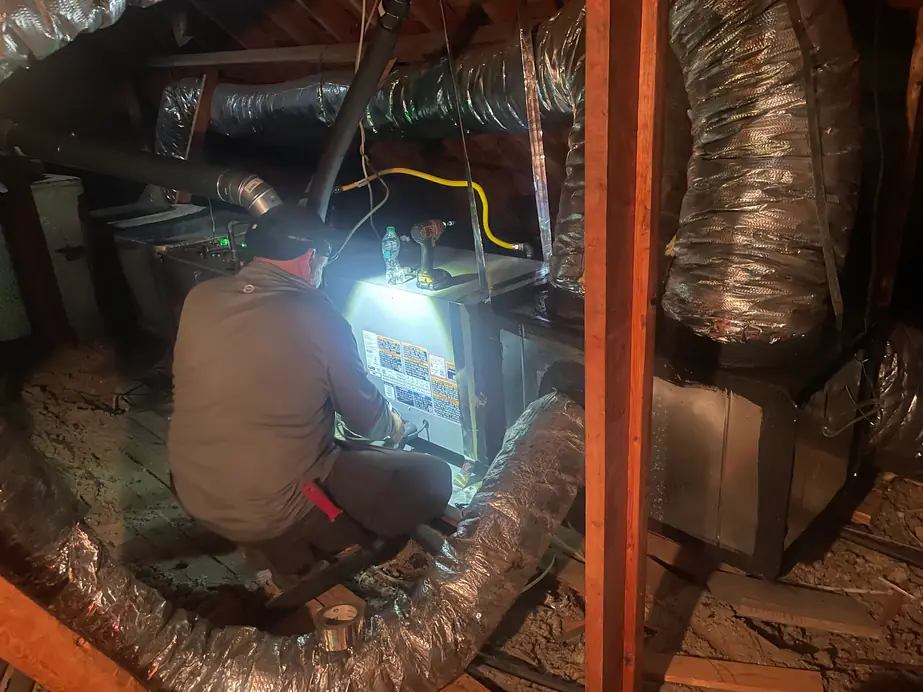
In the photo above, a technician is crouched at an attic air handler by headlamp, with ductwork around him in every direction. That's what coil work is: tight, hot and detailed. The service list at Dave Lane's Hi-Tech Mechanical includes evaporator and fan coil service, covering cleaning, repairs and replacements, and it depends on what the technician finds.
A routine visit usually includes inspecting the coil where it's accessible, clearing and flushing the condensate line, checking that the pan is clean and sound, and testing that the float switch does its job. If a coil has a leak, or has corroded beyond cleaning, replacement is the honest repair, and a good technician will show you what they found before recommending it.
That kind of explanation matters. One Google reviewer, Crucita Torres, put it this way: "they walk you through all their findings and explain the repairs needed." When the problem is out of sight in your attic, that's what you're actually paying for.
UV lights and the air you breathe
Because the coil stays cold and wet, it's where biological growth likes to settle. Some homeowners add an HVAC UV light, which mounts near the coil and is designed to discourage growth on its surface. It isn't a replacement for cleaning, and it doesn't fix a clogged drain, but it can be part of a plan if musty smells or allergies are a concern.
UV lights also sit alongside other indoor air quality options, such as air purifiers and ventilation improvements. Whether any of them make sense for your house depends on what's happening inside it, so it's worth asking a technician to look at the system first.
If you've spotted a stain, a musty smell or a drain line that has gone quiet, call (713) 960-4269, or read about routine service on the maintenance page at /services/hvac-maintenance.
Dave Lane's Hi-Tech Mechanical Inc., (713) 960-4269
Call (713) 960-4269More articles
Why Your AC Runs All Afternoon When the Air Handler Lives in the Attic
A long run cycle on an August afternoon isn't always a broken system, but it is always a clue about your attic.
What "Pulling a Vacuum" Means on a New AC Install, and Why to Ask About It
It's one of the least visible steps of a new installation, and one of the easiest to skip without you ever knowing.